
Optimizing Lentiviral Vector Production
Introduction
Lentiviral vectors (LVVs) are widely used to introduce genetic payloads into dividing and non-dividing cells. Their ability to support stable transgene expression has made them a central delivery platform for gene-modified cell therapies, including CAR-T-cell programs, hematopoietic stem-cell therapies and engineered immune-cell applications.
Transient LVV production commonly relies on the coordinated transfection of several DNA constructs into HEK293 or HEK293T producer cells. Depending on the vector generation and process design, the system may include a transfer construct together with separate plasmids encoding gag/pol, rev and an envelope protein such as VSV-G. Each component must reach the producer cells in the required ratio and retain its intended sequence, topology and expression performance [1].
Upstream DNA is therefore a critical process input. Construct identity, sequence integrity, supercoiled content, purity, consistency, and supply continuity can influence transfection performance, process reproducibility and the impurity load entering downstream purification [1,2].
PlasmidFactory manufactures custom LVV transfer and packaging constructs across flexible quality grades, from Research Grade to GMP Grade, and from development quantities to gram scale, depending on construct, format and grade. We amplify established customer systems, support construct adaptation and convert suitable components into Minicircle DNA for process-development studies.
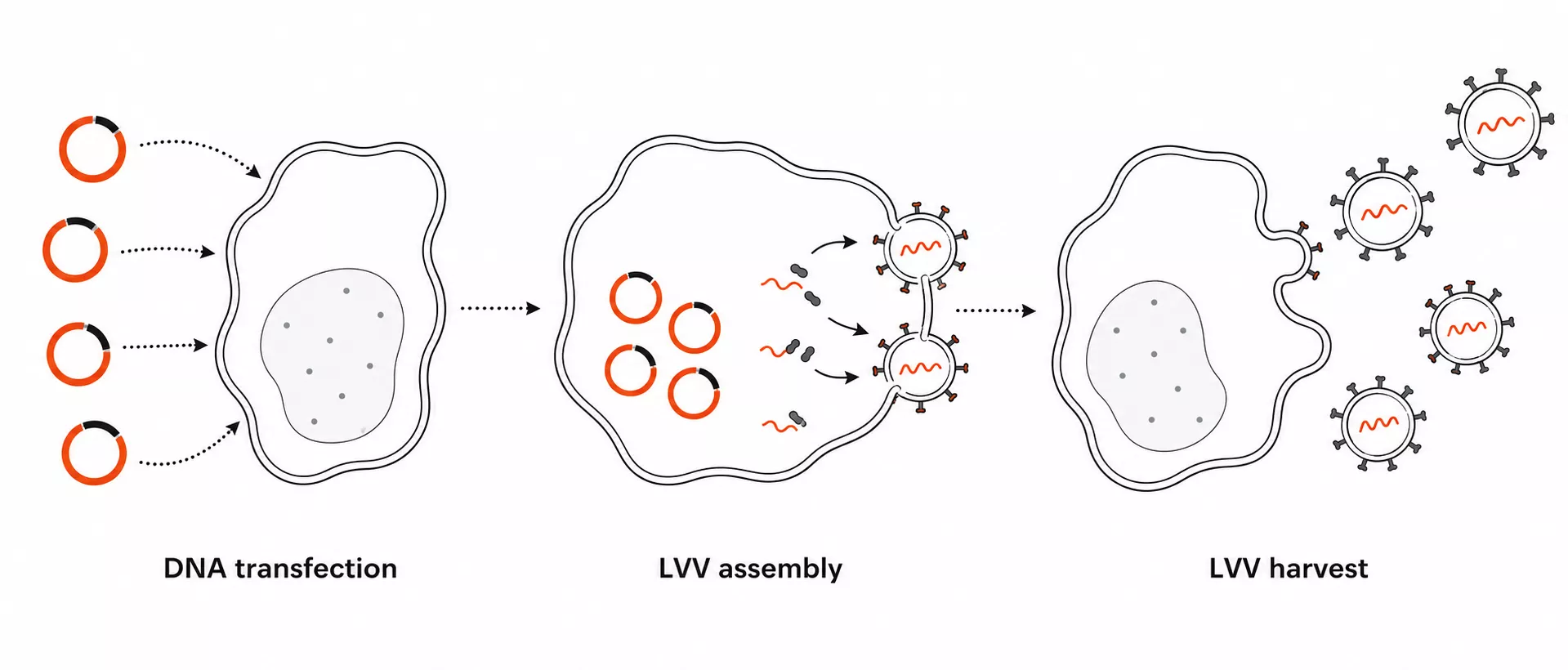
The challenge
LVV manufacturers must coordinate a multi-component upstream system while protecting the activity of a fragile enveloped vector. Common development and manufacturing challenges include:
- Multi-plasmid complexity: LVV systems commonly use several DNA components whose stoichiometry and co-transfection performance must remain controlled across scales.
- Variable transfection and vector yield: DNA concentration, topology, purity and complex formation with the transfection reagent influence delivery into producer cells [1–3].
- Residual DNA burden: Transient transfection introduces substantial quantities of production plasmid DNA into the process stream. Nuclease treatment and downstream purification must control residual plasmid and host-cell DNA [1,2].
- Difficult or unstable constructs: Large transfer plasmids, repeated sequences and complex viral elements can challenge bacterial amplification and analytical control.
- Scale and supply continuity: Process development, toxicology, clinical manufacturing and commercial readiness require consistent material, documentation and a defined path between quality grades.
- Regulatory expectations: Clinical programs require defined controls for the identity, purity, traceability and quality of plasmid DNA used as a manufacturing input.
The solution
A flexible DNA foundation for your LVV platform
PlasmidFactory works with customer-owned LVV systems and manufactures the DNA components required by the selected production process. The service is platform-agnostic: Customers retain their vector architecture, promoters, payloads and preferred producer-cell and transfection platforms.
Complete multi-plasmid system support
We manufacture transfer, gag/pol, rev and envelope constructs individually or as a coordinated project. A common manufacturing route can simplify sourcing and support consistent quality control across the complete DNA set.
- Customer-defined systems: Amplification of established two-, three- or four-component LVV plasmid sets
- Difficult constructs: Experience with large, repetitive and structurally challenging D NA molecules.
- Flexible quantities and formulation: Supply from development quantities to gram scale in the requested concentration, buffer, aliquot format, and quality grade up to GMP.
- Analytical control: Identity and quality testing selected to match the quality grade and stage of development.
- Minicircle DNA format: Increase process efficiency with small, supercoiled, monomeric and functional bacterial backbone-free Minicircles
High supercoiled content and controlled purity
DNA topology and purity are important parameters for reproducible transfection. For CCC Grade and higher, PlasmidFactory specifications include ≥95% total ccc content (construct-dependent) and endotoxin levels ≤10 EU/mL. Capillary gel electrophoresis quantifies supercoiled, open-circular and linear isoforms with greater resolution than conventional agarose-gel assessment.
Quality grades from research to GMP
PlasmidFactory offers Research Grade, CCC Grade, High Quality (HQ) Grade and GMP Grade DNA. The appropriate grade depends on the intended use, development stage and regulatory strategy. Quantities range from development scale to gram scale, depending on construct, DNA format and quality grade. Find out more about our Quality Grades.
Minicircle DNA as an LVV process optimization opportunity
Minicircle DNA contains the functional eukaryotic expression cassette without functional bacterial backbone, lacking in example antibiotic-resistance markers. This smaller, supercoiled, monomeric format can be applied for suitable LVV transfer or packaging components to increase manufacturing efficiency.
For transient LVV production, Minicircle DNA provides a clear upstream engineering rationale:
- Lower DNA mass at equal molarity: Removing the bacterial backbone reduces the total DNA mass required to deliver the same molar number of expression cassettes.
- No functional bacterial backbone in Minicircle DNA: The Minicircle components do not introduce functional bacterial sequences such as origin of replication or antibiotic-resistance genes into the producer-cell transfection.
- Flexible implementation: A transfer construct, one or more packaging constructs, or the complete transient system can be evaluated in Minicircle format where construct design and manufacturing feasibility permit.
- Process-optimization potential: Lower DNA mass may reduce DNA toxicity and may support more efficient transfection and better LVV yield.
Published application evidence
Peer-reviewed studies document the use of PlasmidFactory DNA in LVV production. Together, they show that our plasmids have supported functional vector generation in research, GMP-compliant workflows and commercial-scale bioreactor production.
Complete four-plasmid system at large bioreactor scale
Leinonen et al. reported LV-GFP and LV-TK production using a third-generation four-plasmid system comprising pVSV-G, pGag-Pol, pRev and LV transfer plasmids manufactured by PlasmidFactory. The process scaled from flasks and iCELLis Nano units to an iCELLis 500 bioreactor. The resulting LV-TK demonstrated infectivity and transgene-specific potency [4].
Functional LVV production and CAR-T-cell application
Luostarinen et al. produced two third-generation LVVs by PEI-mediated transfection of pVSV-G, pGag-Pol, pRev and a transfer plasmid. PlasmidFactory manufactured the packaging plasmids and the GFP transfer plasmid. The vectors successfully transduced primary human T cells, and the LV-CD19-CAR workflow generated functional CAR-T cells [5].
Packaging plasmids for GMP-compliant LV production
Sundarasetty et al. used fully sequenced, ccc-supercoiled packaging plasmids produced by PlasmidFactory for GMP-compliant production of LV-G242T. The authors described the plasmids as enzyme-free, free of animal-derived materials and certified for purity. The LV-programmed dendritic-cell product stimulated TRP2-specific autologous cytotoxic T cells from melanoma patients in vitro [6].
Related evidence in clinical-grade retroviral manufacturing
Van der Loo et al. used PlasmidFactory CCC Grade plasmids to manufacture five self-inactivating gamma-retroviral vectors under cGMP conditions in a closed Wave Bioreactor process. This publication does not concern LVV, but it provides related evidence for scalable, clinical-grade retroviral vector manufacturing with PlasmidFactory DNA [7].
Minicircles with viral expression cassettes and their use (US Patent 9,382,552 B2) [8]
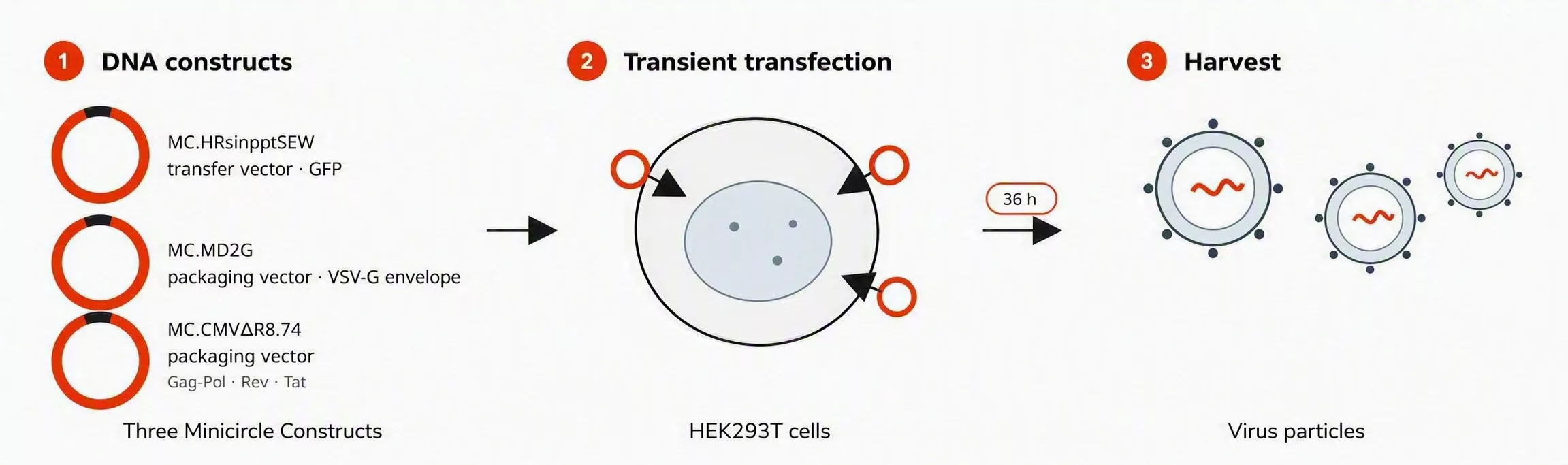
Conceptual summary of Minicircle-based lentiviral particle production described in US Patent 9,382,552 B2, Example 12. HEK293T cells were transiently transfected with three Minicircle DNA constructs providing the transfer, envelope and packaging functions. Virus particles were harvested after 36 hours.
References
- Merten, O.-W., Hebben, M. & Bovolenta, C. (2016). Production of lentiviral vectors. Molecular Therapy – Methods & Clinical Development, 3, 16017.
- Hu, Y. et al. (2024). Liter-scale manufacturing of shelf-stable plasmid DNA/PEI transfection particles for viral vector production. Molecular Therapy – Methods & Clinical Development, 32(1), 101194.
- Carreño, A. et al. (2024). Tuning plasmid DNA amounts for cost-effective transfections of mammalian cells: when less is more. Applied Microbiology and Biotechnology, 108, 98.
- Leinonen, H. M. et al. (2019). Preclinical Proof-of-Concept, Analytical Development, and Commercial Scale Production of Lentiviral Vector in Adherent Cells. Molecular Therapy – Methods & Clinical Development, 15, 63–71.
- Luostarinen, A. et al. (2024). Optimizing lentiviral vector formulation conditions for efficient ex vivo transduction of primary human T cells in chimeric antigen receptor T-cell manufacturing. Cytotherapy, 26(9), 1084–1094.
- Sundarasetty, B. S. et al. (2015). Lentivirus-induced “Smart” dendritic cells: Pharmacodynamics and GMP-compliant production for immunotherapy against TRP2-positive melanoma. Gene Therapy, 22(9), 707–720.
- van der Loo, J. C. M. et al. (2012). Scale-up and manufacturing of clinical-grade self-inactivating gamma-retroviral vectors by transient transfection. Gene Therapy, 19(3), 246–254.
- PlasmidFactory GmbH & Co. KG. US Patent 9,382,552 B2. Minicircles with viral expression cassettes and their use in the transformation of cells for generating recombinant virus or viral gene vectors. Example 12.