“Cutting time at the expense of process control or product quality is not what I would consider fast manufacturing.”
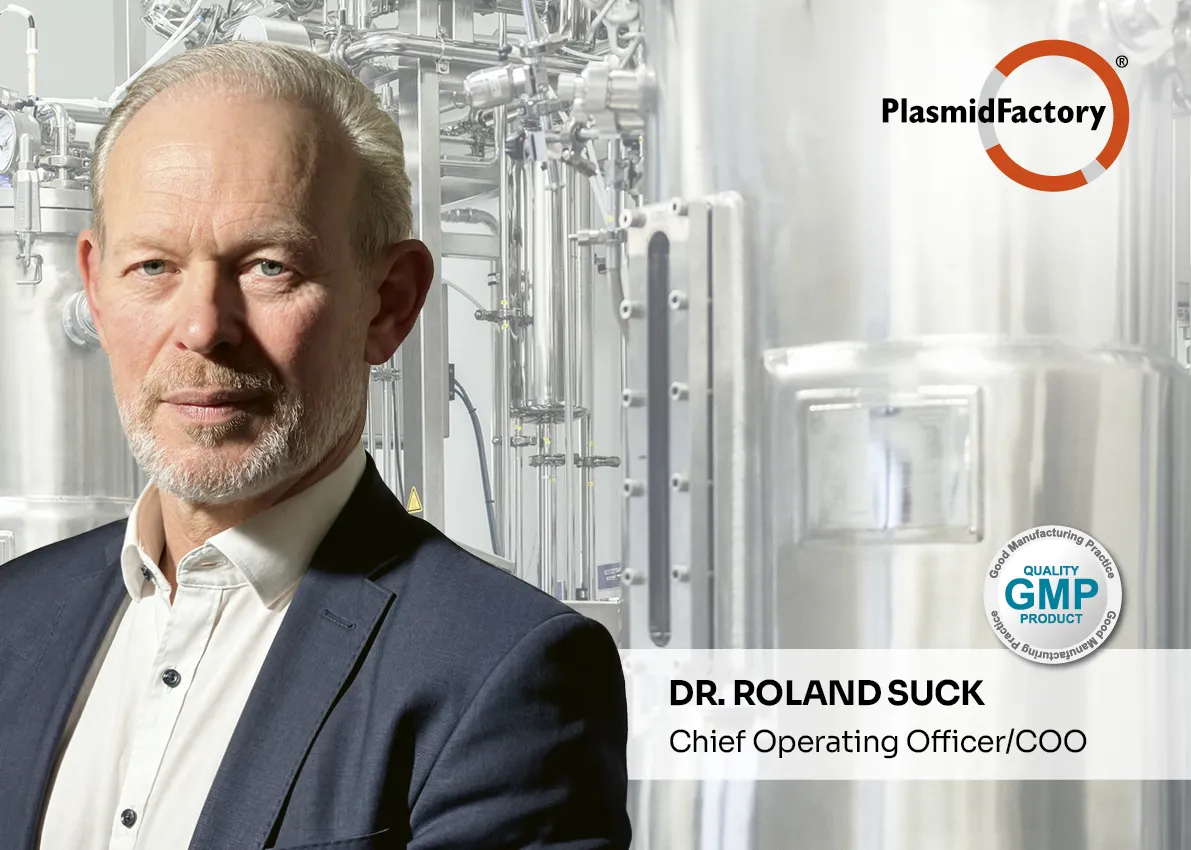
Interview with Dr. Roland Suck, Chief Operating Officer, PlasmidFactory GmbH
How process experience enables short, reliable lead times in cutom DNA manufacturing
PlasmidFactory GmbH, based in Bielefeld, Germany, is a specialized CDMO for plasmid and Minicircle DNA manufacturing. With more than 25 years of experience, defined quality grades and GMP manufacturing capabilities, the company supports cell and gene therapy developers from early research to clinical and commercial manufacturing.
In this interview, Dr. Roland Suck, Chief Operating Officer at PlasmidFactory, discusses why lead times are critical in ATMP development, what determines realistic project timelines, and how PlasmidFactory combines efficient custom manufacturing with controlled quality processes.
Lead times in custom DNA manufacturing are often seen as one of the most important production topics. Why do they become strategically important in ATMP development?
Dr. Roland Suck:
From my perspective, DNA production lead times have to be seen in the context of the overall development plan. DNA manufacturing is usually one step in a larger sequence of activities, including vector production, cell engineering, analytical testing and regulatory activities.
If the required DNA material is delayed, other milestones may also shift. A missing DNA batch can affect vector production slots, release testing or the preparation of material for IND- or CTA-related activities.
That is why we see that customers involve us earlier in the planning process and a respective slot reservation at our manufacturing facility is strongly recommended. Also, it is required or even essential to know when material can realistically be available and whether the manufacturing route fits their next development step.
For us, reliable lead-time planning is part of supporting the customer’s development strategy.
When customers ask for short lead times, what has to be in place internally to make that possible?
Dr. Roland Suck:
A lot depends on what happens before production actually starts.
We first review and investigate the construct and its manufacturability before defining the manufacturing details. Large plasmids or constructs containing technically challenging elements such as ITRs, repetitive regions or long poly(A) sequences may require closer evaluation before we define manufacturing details.
Another important factor is plasmid copy number. Whether we are dealing with a high-copy or low-copy plasmid affects how much DNA can be generated per cell and, consequently, the amount of biomass required to reach the target quantity.
These construct characteristics may also influence plasmid stability during cultivation and how the material behaves later during downstream processing.
Our project management also brings production, QC and QA into the planning early, so the manufacturing route and the required testing are reflected in the timeline from the start.
We do not start every project from scratch. Over many years, we have built up a portfolio of production strains, optimized conditions and manufacturing processes that provide adequate solutions for various types of plasmids and minicircles. It is key to know where these processes can be applied directly and where the characteristics of a particular construct require adaptation.
In fermentation, biomass development is one of the relevant process parameters. But it has to be considered together with the amount and stability of the plasmid DNA generated during cultivation and the requirements of the subsequent downstream process.
Some activities can be prepared in parallel, while others have to follow a fixed sequence because one result determines the next step.
Another important point for me is communication. If a construct behaves differently than expected, the customer needs to know early. That gives both partners the opportunity to adjust the plan before a technical challenge develops into a timeline challenge.
What are realistic lead times for custom DNA manufacturing projects?
Dr. Roland Suck:
The timeline depends very much on the factors I just mentioned. A construct that follows an established manufacturing route is obviously different from a project that requires more attention in terms of additional evaluation or process adaptation. The required quality grade and analytical scope also influence how much time is needed.
As a rough orientation, a straightforward Research Grade project can often be completed in around three weeks. A more complex High Quality project may require seven to eight weeks, especially when additional analytics, documentation or construct-specific work is involved.
For GMP projects, the overall timeline is more extensive and can take about ten and a half weeks because cellbanking, manufacturing, QC, QA documentation and release requirements have to be aligned in more detail.
This is why we prefer to discuss timelines project-specifically. Our project management coordinates the project from the start and aligns the customer requirements with production, QC and QA. We clarify the required DNA format and Quality Grade early, reserve the manufacturing slot and include the necessary testing and release activities in the schedule.
That gives our customer a realistic manufacturing and release timeline from the beginning. If requirements change, the relevant teams are already involved and we can adjust the plan quickly.
This close coordination is one of the reasons we are able to offer short and reliable lead times, especially in custom manufacturing.
Your GMP facility was purpose-build for plasmid and Minicircle DNA manufacturing. Which design features are particularly important for reliable custom manufacturing?
Dr. Roland Suck:
Preventing cross-contamination was one of the most important considerations when we designed our GMP facility.
Our GMP setup uses single-use equipment throughout upstream and downstream processing. All components that come into contact with the product during manufacturing are single-use, ensuring for each project an environment that has never been in contact with material from a previous manufacturing campaign.
From an operational perspective, this means that each new manufacturing campaign starts with a newly assembled product-contact pathway based on qualified single-use components. I sometimes describe it as giving each project its own and dedicated process equipment.
In custom DNA manufacturing, different customer constructs are manufactured in the same facility. Between campaigns, the single-use components that have been in contact with the product are replaced. This reduces or even eliminates cross-contamination risk and avoids extensive cleaning which is necessary for multipurpose equipment before the next manufacturing run.
It also supports more operational flexibility because extensive cleaning procedures for reusable product-contact equipment do not become the determining factor between each manufacturing run.
How does your process experience help you translate different plasmid characteristics into a robust manufacturing process?
Dr. Roland Suck:
We have spent more than 25 years optimizing DNA manufacturing processes, from cultivation and fermentation through lysis and purification. During that time, we have worked with very different plasmid and Minicircle constructs, and their behavior in production can vary considerably.
One of the first decisions is the production strain itself. We work with several intensively characterized l E. coli strains and select the most suitable production clone after transformation. We then adapt specifically the manufacturing process for that particular construct and production clone. Having worked with many different constructs over the years gives us a strong basis for dealing with technically demanding production behavior.
After fermentation, the next challenge is recovering the plasmid from the cells. We need to release the plasmid efficiently from the cells while handling a large and structurally sensitive DNA molecule. Process conditions and mechanical stress can affect plasmid integrity and topology, so this step has to be well controlled before the material moves into purification.
During purification, we remove host-cell impurities such as RNA, genomic DNA, proteins and endotoxins while preserving the required topology profile. Supercoiled, open-circular and linear DNA behave differently, and for many of the applications our customers work on, the supercoiled form is the preferred one.
We see that particularly in cell and gene therapy workflows involving DNA transfection, where topology can influence transfection efficiency, for example. It is also relevant when plasmid DNA is used as the starting material for mRNA production. If the plasmid is going to be linearized before IVT, you want to start from a well-defined and intact DNA template. A high proportion of supercoiled DNA provides a more controlled basis for the linearization step.
For CCC Grade and higher, our frame-specification is ≥95% supercoiled DNA, with values often around 98% depending on the product and specification.
This is where many years of process optimization make a practical difference. Our experience with production strains, fermentation, lysis and purification helps us adapt the process when a construct is particularly demanding and maintain the DNA characteristics that are important for the customer’s intended application.
What is one misconception about fast custom DNA manufacturing that you would like to correct?
Dr. Roland Suck:
A common misconception is that lead time is mainly determined by how fast the production run can be completed.
A substantial part of the timeline is determined before production starts. If we understand the construct, the intended application and the required quality level early, we can define the appropriate manufacturing route and plan the project accordingly.
Some process steps also simply require a certain amount of time. Cutting that time at the expense of process control or product quality is not what I would consider fast manufacturing.
We understand where DNA manufacturing sits within an ATMP development program, and our project management coordinates production, QC and release accordingly. We give customers a realistic timeline from the beginning and address foreseeable bottlenecks before they affect the project. For me, that is what efficient and reliable DNA manufacturing means.