

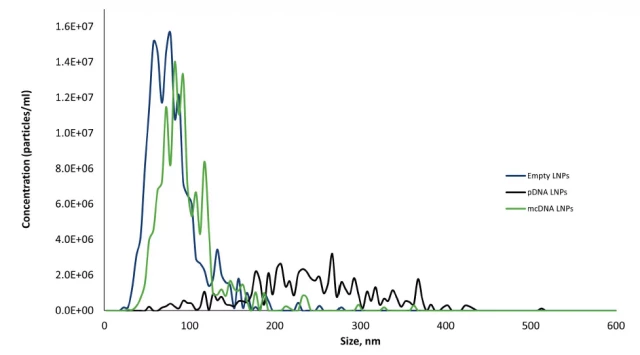
Ready-to-use lipid nanoparticle delivery kits can help reduce the need for extensive in-house formulation and screening during early-stage nucleic acid delivery research. In this collaborative work between PROGEN, ZentriForce, NanoFCM and PlasmidFactory, presented at ASGCT 2026, the PROGEN mRNA LNP Delivery Kit was characterized using nano-flow cytometry (NanoFCM), Dynamic Light Scattering (DLS) and Nanoparticle Tracking Analysis (NTA) and evaluated beyond mRNA delivery by testing plasmid DNA and Minicircle DNA reporter constructs in vitro.
The study showed that DNA constructs could be delivered using the mRNA LNP Delivery Kit. However, the DNA format influenced both particle characteristics and functional output. Plasmid DNA-loaded LNPs showed larger diameters and higher polydispersity, while Minicircle DNA-loaded LNPs showed particle size distributions closer to empty LNPs under the tested formulation conditions. In reporter assays, Minicircle DNA constructs also produced higher luciferase signals than the corresponding plasmid DNA constructs.
These findings from the PROGEN / PlasmidFactory collaboration support the use of ready-to-use mRNA LNP systems as practical tools for DNA cargo delivery in preclinical applications. They also show why DNA cargo architecture is important: compared with conventional plasmid DNA, Minicircle DNA enabled DNA-loaded LNPs with particle characteristics close to empty LNPs and produced higher luciferase reporter signals. By removing bacterial backbone sequences and reducing overall construct size, Minicircle DNA provides a more suitable DNA architecture for this LNP delivery setup and strengthens its role in non-viral nucleic acid delivery workflows.