“Building GMP DNA Manufacturing to Support Therapies of Tomorrow”
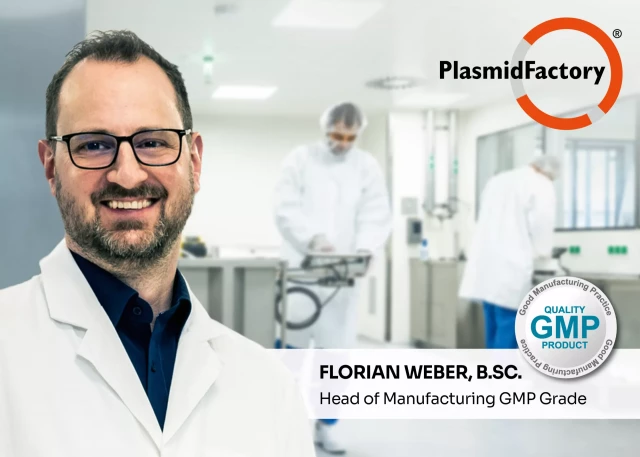
Interview with Florian Weber, Head of GMP Production, PlasmidFactory GmbH
PlasmidFactory GmbH, based in Bielefeld, Germany, has supported scientists for more than 25 years as a specialized CDMO for plasmid and Minicircle DNA. As the only provider worldwide offering GMP-grade Minicircle DNA, the company plays a unique role supporting advanced cell & gene therapy as well as vaccine-related development, and its DNA is already used in several clinical programs.
Expectations toward DNA manufacturing have changed significantly in recent years. What developments made a purpose-built GMP facility necessary?
Florian Weber:
Gene and cell therapy has matured. What used to be highly experimental is now moving through structured clinical development and expectations toward DNA as starting material have evolved accordingly.
We see more virus-free engineering concepts, higher doses for in vivo settings, and an overall push toward scalability and reliability. That changes what GMP really needs to deliver. It’s no longer just about meeting formal requirements; it’s about providing a manufacturing platform that developers can rely on long-term.
Instead of adapting legacy infrastructure, we built a dedicated GMP facility specifically for plasmid and Minicircle DNA production. It includes clearly separated process areas and a fully end-to-end single-use workflow designed to prevent cross-contamination and support consistent product quality across batches and programs.
Which design or process decisions have the greatest impact on robustness and product quality in daily operation?
Florian Weber:
Robustness starts with focus. We have been manufacturing DNA for more than 25 years and that specialization shows in how our processes are structured.
One key element is our fully single-use manufacturing concept combined with controlled cleanroom environments and pharmaceutical-grade utilities such as qualified water systems to create a stable, predictable production setting. These features support consistent quality, regulatory compliance, and suitability for late clinical and commercial supply.
Equally important is vertical integration. Core manufacturing and analytical steps are performed in-house under GMP conditions, including comprehensive quality control and in-house QP batch release. This tight integration between production and QC means we can react quickly, maintain transparency, and support customers proactively especially when programs evolve or regulatory questions arise.
For advanced therapies, this level of control isn’t a luxury - it’s essential.
Quality control is often discussed mainly in the context of compliance. From your experience, what role does integrated QC play in supporting next-generation cell & gene therapy programs?
Florian Weber:
For virus-free cell modification approaches, DNA is not just a raw material - it becomes a defining component of the therapeutic strategy.
In these settings, purity, topology, and residual impurities directly influence performance and safety. That’s why we view QC not as a regulatory hurdle, but as a scientific tool. Close integration between analytics and manufacturing allows us to monitor critical quality attributes continuously and ensure that what leaves our facility performs as expected in demanding biological systems.
This is particularly relevant for Minicircle DNA. At the process level, Minicircles can reduce the DNA burden per application: their compact, backbone-free structure supports strong expression with lower DNA input, which can translate into reduced transfection stress, improved reproducibility, and lower downstream variability. In addition, simplified DNA architectures - particularly in workflows such as virus-free cell therapy or AAV production - streamline processes and ease analytical and QC demands, contributing to more efficient and cost-conscious manufacturing.
The fact that GMP-grade Minicircle DNA is already being used in ongoing clinical trials demonstrates that this approach is not theoretical - it performs under real clinical conditions.
PlasmidFactory is the only provider offering GMP-grade Minicircle DNA. Why does that matter for developers?
Florian Weber:
Minicircle DNA is not just a smaller plasmid. It is a different molecular concept: streamlined, backbone-free, and designed for performance in sensitive cells and demanding applications.
For developers pursuing virus-free cell engineering or looking for cleaner starting material for vector or mRNA production, this difference becomes meaningful. It can improve transfection efficiency, reduce unwanted bacterial elements, and support regulatory clarity around starting material purity.
Bringing Minicircles into GMP required long-term expertise in DNA process development, purification, and analytics. It builds on more than two decades of focused DNA manufacturing and today, it allows customers to move from early research through clinical supply without changing vector formats or manufacturing partners.
That continuity reduces risk and increases safety - scientifically and strategically.
Your key message to developers moving toward the clinic?
Florian Weber:
Think about GMP earlier than you think you need to.
DNA decisions made at research stage (e.g. vector format, backbone elements, production platform) influence scalability, safety assessments, and regulatory discussions later on. Working with a specialized DNA manufacturer from the beginning helps avoid painful transitions.
Our role is to provide a stable and scientifically sound manufacturing foundation. With 25 years of focused DNA manufacturing experience, a dedicated GMP environment, and a unique Minicircle platform already supporting clinical programs, we see ourselves as a long-term partner for therapies designed to reach patients, not just proof-of-concept milestones.

Let us know how
we can help.
Get in touch so we can assist you in a targeted manner — either by filling out this online form or emailing us at:
contact@PlasmidFactory.com

I would like personalised advice on the following topic …
- Manufacturing of customized plasmid DNA
- Manufacturing of customized minicircle DNA
- In-Stock products for AAV production
- In-Stock products (reporter-plasmids/-minicircle)
- cooperation opportunities
- Other topic
I would like a specific quote for the following product
- Customized DNA
- AAV plasmids und minicircles
- reporter gene plasmids and minicircles
- pEPito plasmids
- Molecular Size Markers
- CGE Service
- Storage Service
Select
dialogue
provide required
information
receive
offer

We are aware of our responsibility towards our fellow human beings and the environment. We act in accordance with general ESG (Environmental Social Governance) criteria.