“Minicircle DNA removes everything that is unnecessary for therapy, resulting in a cleaner, safer, and more efficient vector.”
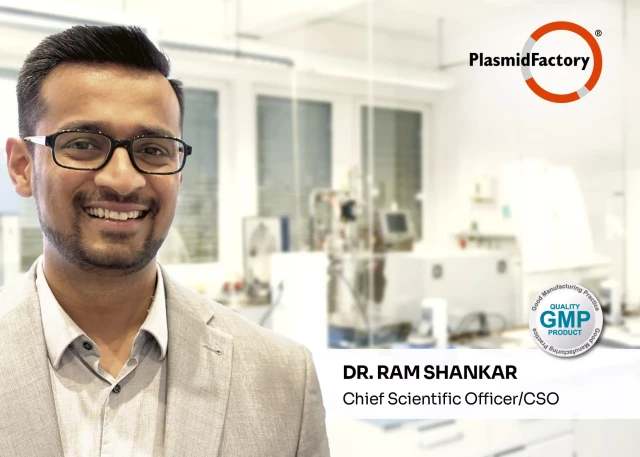
Interview with Dr. Ram Shankar, Chief Scientific Officer, PlasmidFactory GmbH
PlasmidFactory GmbH, based in Bielefeld, Germany, is recognized as a leading CDMO for the production of plasmid and Minicircle DNA. Over the past 25 years, the company has evolved from a small academic spin-off into a global reference for DNA manufacturing in gene and cell therapy. Following the launch of its new GMP facility and the clinical success of several Minicircle-based therapies, PlasmidFactory is entering a new phase expanding its impact from plasmid DNA manufacturing toward next-generation, virus-free gene delivery.
Dr. Ram Shankar, Chief Scientific Officer at PlasmidFactory, shares his insights into the company’s latest developments and the growing importance of Minicircle technology in cell and gene therapy.
You recently presented data on Minicircle-based CAR-T cells at the CAR-TCR Summit in Boston. What makes Minicircles such a breakthrough for gene and cell therapy?
Dr. Ram Shankar:
Minicircles represent the logical next step in non-viral gene transfer. Traditional plasmids contain bacterial backbone sequences like origins of replication, antibiotic resistance genes, and other elements that are not only unnecessary for therapy but can also compromise safety and performance. Minicircles remove these bacterial sequences entirely, leaving only the therapeutic expression cassette in a small, supercoiled DNA molecule.
This design has profound advantages: higher transfection efficiency, stronger and more stable expression, and significantly lower cytotoxicity. Because there are no bacterial genes, the risk of immune activation or gene silencing is minimized. The result is a cleaner, safer, and more efficient DNA vector that is ideally suited for advanced therapies such as CAR-T, TCR-T, or TIL approaches.
How do Minicircles address some of the limitations of viral vectors, such as lentivirus?
Dr. Ram Shankar:
Viral vectors have enabled the first wave of gene therapies, but they come with several drawbacks liek complex production, high cost, limited payload capacity, and concerns around insertional mutagenesis. Minicircles, in combination with transposon systems like Sleeping Beauty or PiggyBac, offer a virus-free alternative that is scalable, cost-effective, and safer.
As shown by Monjezi and colleagues in 2016 and later confirmed by Díez et al. in 2025, CAR-T cells engineered with Minicircle DNA and Sleeping Beauty transposase mRNA achieved potent anti-tumor activity while integrating preferentially into genomic safe-harbor regions. In the 2016 study, Sleeping Beauty integrations occurred roughly six times more often in defined genomic safe harbors as described by Monjezi et al. as “more than 50 kilobases from transcription start sites and several hundred kilobases from cancer-related genes”, compared with lentiviral vectors. This indicates a more favorable integration profile and potentially improved genomic safety.
Moreover, the production of Minicircles is much faster and more economical, requiring no complex viral packaging or higher biosafety-level infrastructure.
Several clinical programs already use Minicircles. Could you share some examples?
Dr. Ram Shankar:
Yes, Minicircles produced at PlasmidFactory have already entered multiple clinical trials, including CARAMBA, TranspoCART19, and LION-1. These programs explore virus-free CAR-T cell generation using transposon systems and hopefully demonstrate strong efficacy and favorable safety profiles.
Our technology has therefore moved well beyond proof-of-concept. It is clinically validated and now ready for late-stage development and commercial translation. We are proud that Minicircle DNA produced by PlasmidFactory contributes directly to these pioneering studies, demonstrating that virus-free engineering is not only possible, but it is the future.
What role does manufacturing quality play in enabling this transition from research to clinic?
Dr. Ram Shankar:
Manufacturing quality is absolutely central to what we do. For 25 years, PlasmidFactory has set the benchmark for high-purity DNA. We offer three quality grades (Research, High Quality (HQ), and GMP) to ensure a seamless transition from early discovery to clinical and commercial production.
Our new GMP facility in Bielefeld, which will be soon fully operational allows us to produce both plasmid and Minicircle DNA at large scale using single-use equipment and rigorous quality controls. To avoid any risk of cross-contamination each product is made under strict segregation - only one plasmid or Minicircle is produced per suite.
Our proprietary purification process delivers DNA with extremely high supercoiled (ccc) content and minimal impurities. These standards meet or exceed current regulatory expectations for advanced therapy starting materials.
PlasmidFactory’s Minicircle technology is patented. How does it differ from other vector systems available today?
Dr. Ram Shankar:
The uniqueness lies both in the molecular design and in the process. Our patented system produces Minicircles by intramolecular recombination from a well-characterized parental plasmid. During the process, the bacterial backbone forms a miniplasmid that is efficiently removed during purification, leaving only the therapeutic Minicircle DNA.
The method is robust, scalable, and license-free for our clients, which is an important advantage. It also allows the production of complex constructs without cargo limitations, supporting polycistronic designs or regulatory elements for fine-tuned expression. Because the same platform is compatible with both research-grade and GMP manufacturing, our customers can easily scale their programs without changing the vector backbone or process.
Beyond CAR-T, where else do you see Minicircle DNA having impact?
Dr. Ram Shankar:
The potential applications are vast. Besides CAR-T and TCR-T cells, we see strong interest in AAV production and RNA manufacturing, where Minicircle DNA could serve as a cleaner, more efficient template compared to conventional plasmids. It eliminates unwanted bacterial sequences, improving both safety and productivity of viral and non-viral vector production processes.
Beyond these, Minicircles are also gaining attention in natural killer (NK) cell engineering, induced pluripotent stem cells, hematopoietic stem and progenitor cells, as well as in vivo gene delivery. A particularly exciting frontier is direct in vivo immune-cell engineering, where Minicircles can be formulated with lipid or polymer nanoparticles (LNPs/PNPs) for systemic, non-viral gene transfer. This could one day enable in vivo generation of CAR-T or TIL cells, avoiding the need for complex ex vivo manufacturing entirely.
What trends do you observe in the broader CDMO landscape for DNA manufacturing?
Dr. Ram Shankar:
We are witnessing an evolution from conventional plasmid production toward specialized DNA formats tailored for advanced therapies with Minicircles being a prime example. Sponsors now require CDMOs that not only manufacture DNA but also understand the underlying biology and regulatory context.
At PlasmidFactory, we combine 25 years of manufacturing experience with deep scientific expertise. Our scientists work closely with clients from vector design through analytical characterization, ensuring that the DNA meets both functional and regulatory requirements. With over 3,500 constructs produced and a 99.9 percent success rate, we offer a level of reliability and know-how that few others can match.
You have recently strengthened your global partnerships. How important is international collaboration, particularly in Asia and India?
Dr. Ram Shankar:
It is very important. India has a rapidly growing biotechnology and vaccine industry with strong interest in RNA and DNA technologies. Together with our local partner, Dr. Nagaraj Rao of RRR Labs, Navi Mumbai, we are building bridges between German DNA manufacturing expertise and India’s dynamic biopharma ecosystem.
This partnership supports Indian researchers and developers by giving them access to the same high-quality DNA, both plasmid and Minicircle, that leading global companies use for their advanced therapy programs. We see great potential for collaboration in the areas of CAR-T development, RNA therapeutics, and DNA vaccine research.
From a scientific point of view, what are your priorities for R&D at PlasmidFactory?
Dr. Ram Shankar:
Our R&D covers the entire DNA production chain – from strain and construct optimization to upstream bioprocessing, purification, and analytical control. We focus on process innovation, plasmid stability, and quality assurance, continuously refining fermentation, purification, and single-use technologies to maximize yield and purity. A key area is the development of next-generation vectors, including non-viral and resistance-gene-free systems such as Minicircles, and their application in AAV and RNA production.
We also investigate plasmid stability under various storage and processing conditions and advance analytical methods such as capillary gel electrophoresis (CGE) and next-generation sequencing (NGS) to ensure precise quality control. At PlasmidFactory, innovation means combining scientific rigor with practical application, ensuring every new development enhances our ability to deliver the highest-quality DNA for research, clinical, and GMP use.
Finally, where do you see the future of PlasmidFactory and of Minicircle technology in the next five years?
Dr. Ram Shankar:
We believe that Minicircle DNA will become a cornerstone of modern gene and cell therapy, complementing both viral and non-viral approaches. As the industry continues to diversify beyond traditional vector systems, the demand for safe, efficient, and scalable DNA starting materials will grow rapidly. PlasmidFactory is ready for that future with proven technology, GMP capacity, and a passionate team dedicated to advancing the science of DNA manufacturing.
In the next five years, we expect to see Minicircles playing an important role not only in ex-vivo CAR-T and transposon-based programs, but also as templates for viral and non-viral vector production, as well as in emerging in vivo applications using LNP-based delivery. This will further broaden the possibilities for gene and cell therapies, making them simpler, safer, and more accessible to patients worldwide.
At PlasmidFactory, our mission remains clear: to provide the cleanest, most reliable DNA possible and to empower researchers and developers to turn genetic ideas into life-saving therapies. DNA is, quite literally, in our DNA.

Let us know how
we can help.
Get in touch so we can assist you in a targeted manner — either by filling out this online form or emailing us at:
contact@PlasmidFactory.com

I would like personalised advice on the following topic …
- Manufacturing of customized plasmid DNA
- Manufacturing of customized minicircle DNA
- In-Stock products for AAV production
- In-Stock products (reporter-plasmids/-minicircle)
- cooperation opportunities
- Other topic
I would like a specific quote for the following product
- Customized DNA
- AAV plasmids und minicircles
- reporter gene plasmids and minicircles
- pEPito plasmids
- Molecular Size Markers
- CGE Service
- Storage Service
Select
dialogue
provide required
information
receive
offer

We are aware of our responsibility towards our fellow human beings and the environment. We act in accordance with general ESG (Environmental Social Governance) criteria.